

MATHEMATICS: A Quintessential Introduction to Mindscience, Grossberg, and God. Part 3
A friendly tutorial on how to make sense of mental dynamics from a cosmic perspective. This article starts exploring the MATHEMATICS of our super-simple thinking network.

Part 3: Mathematics
      Neural networks are defined by systems of nonlinear differential equations.
            .Stephen Grossberg, Conscious Mind, Resonant Brain
.1
Now we attempt to characterize the mechanics of our simple thinking system in the language of mathematics.
Before we do, let us confront one of the deepest and most controversial questions that any seeker, scientist, or spiritualist must confront if they hope to crack the secrets of reality:
Which is more fundamental?
Mechanics? Or Mathematics?
No consensus has yet bloomed among scientists, mathematicians, and philosophers. In academia, the question is the very definition of contention.
Physicist Max Tegmark takes the extreme position that everything is math—that physical reality consists of a pure mathematical object refracted through our conscious experience. The view that math is the most fundamental reality is commonly regarded as Platonism, after Plato, the first to argue that our experienced reality was a shadow or echo of the “true real world,” an inaccessible yet somehow knowable world of perfect mathematical objects. Mathematician Roger Penrose (who oafishly claimed consciousness is formed from quantum microtubules) is another Platonist, as is physicist Stephen Wolfram, who believes reality is forged by pure mathematical algorithms.
Platonism remains a minority view among physicists, though a significant minority. Among quantum physicists, last year only 36% believed the wavefunction (the mathematical characterization of the quantum mechanics of a system) was physically real (and thus the “fundamental truth”) while 47% believed the wavefunction was a mathematical tool useful for characterizing the fundamental mechanical truth. The only survey I could find of mathematicians and their convictions regarding reality was a recent poll of five prominent mathematicians that found four of them believe mathematical objects truly exist and are physically real. Among philosophers (generally amateurs at math and physics), in 2010 about 40% were Platonists who believed that mathematical objects physically existed and were the ultimate reality, while almost the same number believed that they did not and were not (Quintessentialism).
There should not be any controversy over this.
Here we see the profound constraint on imagination and insight imposed by needless academic specialization. Physicists know only physics. Mathematicians know only math. Philosophers don’t know science or math. None know of thinking or consciousness or how meaning and comprehension are created out of neural dynamics. None know how mathematical thinking and mathematical consciousness are created out of neural dynamics. And yet, these blinkered and insular academics are trying to reach firm conclusions regarding the ultimate cosmic relationship between physics, math, philosophy—and human awareness of said relationship.
What is the deeper truth—mech or math?
Superlearning provides a firm answer:
Mechanics.
Physical change, material dynamics, corporeal action—this is ground truth. This is what’s real. This is what’s happening in reality. Mechanical processes working with and against other mechanical processes. This is the Commonality: endless mechanical activity.
Mathematics, on the other hand, is not ground truth.
Math is not what’s real.
Math is not what’s happening.
Math is how two brains talk about the mechanical reality to one another. Math is how we communicate our understanding of mechanics to other minds through language that is precise to any desired degree and flexible to any desired degree.
Math is kin to maps and flow charts and recipes and a human hand pointing.
Not religion. Not divinity existing in an inaccessible dimension. Not the Kabbalah or clairvoyance or astral projection—all variants of Platonism.
Why do Max Tegmark, Roger Penrose, Stephen Wolfram, Plato, most mathematicians, 47% of physicists, and 40% of philosophers get the most fundamental question about the ultimate nature of our reality wrong?
Because of the Natural Fallacy of Sentience.
The human mind is biologically prone to mistaking activities for things. Physicists have long been Platonists: they once thought the activity of heat was a substance, caloric. Chemists are Platonists: they once thought the activity of combustion was the substance phlogiston. Biologists are Platonists, too: they once thought the activity of life was the substance elan vital. Mindscientists and philosophers are Platonists: a majority of both believe that the (activity of) consciousness is an unsolvable hard problem (David Chalmers thinks consciousness is a fundamental primitive like charge and mass), because they cannot imagine what sort of THING consciousness could be.
Our minds evolved through natural selection to think an abstract idea is a real THING. Indeed, there are a great many things that only exist if you think they exist, such as money, beauty, and justice—and the reason they exist is because of the Natural Fallacy of Sentience, which mechanically compels us to believe these abstract ideas are physical things in the world.
Math is yet another THING that exists only if you believe it exists. (Try proving to an orangutan that math exists… or to a praying mantis…)
All the weird feelings of reification you may experience while contemplating mathematical objects like circles and π and integrals and tangents and √2—the same feelings experienced by Tegmark and Plato and Wolfram and G. H. Hardy and David Chalmers and Lavoisier and Henri Bergson and even Kurt Godel when they ponder math—feelings so real and vivid, feelings so right and necessary, that somehow you experience mathematical concepts as more pure and pristine than material objects you can hold in your hand, almost transcendentally pure and right. . .
. . . all these gripping and preternatural feelings of incarnation are merely the psychological consequence of modular resonance in your brain. The consequence of the natural fallacy of sentience.
Whenever you are conscious of an idea—even a mathematical idea—resonance causes that idea to feel like a vividly real THING.
But it is only an idea.
I’ve spent my entire life listening to everyone tell me I am delusional—not rigorous enough, not penetrating enough. Instead, I’m advised to be more like Tegmark and Chalmers and Wolfram, celebrated and grounded and keen.
But these folks all got duped by one of the most basic fallacies to derange human conception. A rookie mistake…
These are folks who believe that, no—money must be real! Life must be a substance, an energy! Consciousness must be a cosmic fundamental! No, beauty is not in the eye of the beholder—it is an ultimate truth!
These individuals remain adrift in their over-narrow conception of reality resulting from a cloistered life of academic insularity and emotional immaturity.
Math is people talking to one another about the world.
There is no part of mathematics that was not invented by humanity. (If you say AI has done some math, I say AI is a mindless invented extension of humanity.)
It’s easy to imagine the interesting and compelling stuff we invent is transcendent and otherworldly. And it is! But not in the way our evolved brains tell us it is.
Kings generally tend to believe in the divine right of kings. Why would I be King if god did not intend it to be so? Thus, my reign is divinely sanctioned!
Kings and prime numbers certainly exist, but they do not exist because they are special entities reflecting God’s will or a Platonic realm.
It’s easy for mathematicians to believe they are discovering something that’s “out there” rather than inventing something “in here.” That’s how poets feel, too, when they discover a lovely turn of phrase—"Beauty is truth, truth beauty. That is all ye know on Earth, and all ye need to know.” The verses of Ode to a Grecian Urn were always waiting out there in a Platonic realm of verbiage, just waiting for a mind to discover them and share the perfect Platonic verses with the world, is how Keats felt. Michelangelo didn’t invent his sculpture of David—it was hidden there in the marble awaiting discovery by Michelangelo, he felt.
Minds think all sorts of things are out there in the cosmos, somewhere, hidden. God, the Big Bang, nothingness, poltergeists, mathematical objects. . . But the fact remains, the only evidence any physicist, mathematician, or philosopher has to go on regarding the existence of a Platonic realm—the ONLY evidence whatsoever—are their feelings. These women and men feel that something so beautiful and self-evident and emotionally stirring must exist.
Which is, of course, the exact same reasoning used by believers to justify their faith in the existence of god: because of how the idea FEELS.
Max Temark believes that math is real (and ultimate). But he perhaps only believes such beliefs because his mind is so consumed by such thoughts—thoughts of math and its wondrous nature—he didn’t spend his mind on much else.
If he had, perhaps he would’ve broken out of his monomania provoked by the Natural Fallacy of Sentience.
1.5 A Dilemma
Let me give voice to one of the most stubborn and seemingly intractable problems I perpetually face when I attempt to explain Quintessentialism to you. I’m always stuck choosing between the easy and the hard.
I always want to render the science, math, and engineering in terms as lucid, forthright, and clear as possible. I want to make it easy as possible to grasp ideas, no matter your background.
The problem is, when I make things too simple, it’s easy to doubt they are factual and accurate. Maybe my explanation is not rooted on truth, is how it can feel when I proclaim God is finite!
The solution would seem to be to provide more details—more data, more equations, more explanations, more interdisciplinary connections.
But in this case I confront the opposite problem—things quickly grow complicated and hairy. Readers don’t want to hack and slash their way through brambles of tangly mathematical formulation. Confronted with the full evidence and explication of High Science, too many readers feel daunted and exhausted and turn away.
This is a deep problem of communication and epistemology that applies to any complex mechanical phenomenon, constraining cosmic revelation. In this article I am compelled to deploy the hard explanation, because this is where I must provide a firm and thorough accounting of the mathematics of Mind.
.2 The Equations
Let’s explore the mathematics characterizing our simple neural circuit.
Here is the mechanical representation of the system, showing what is connected to what and what’s flowing where. There are two neurons.
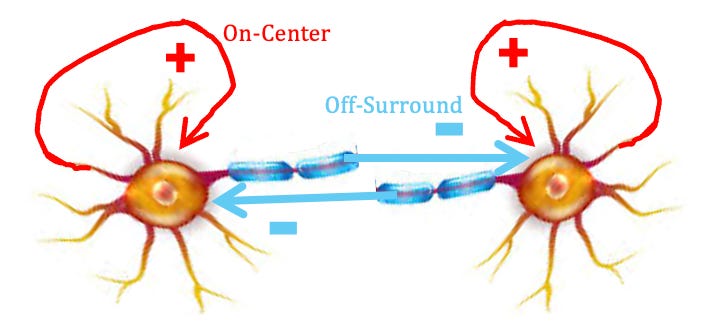
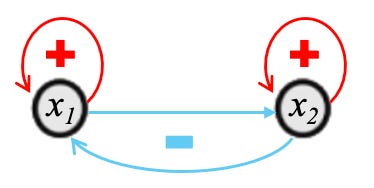
We can render these mechanics as a mathematical abstraction, rendering the thinking system in abstract terms of values, flows, and interactions:
Let’s mathematically characterize the DYNAMICS of this thinking system. Its PURPOSEFUL DYNAMICS.
What matters most in this thinking system is the ACTIVATION of the two neurons, who we might refer to as Neuron 1 and Neuron 2. The ACTIVATION level or intensity of Neuron 1 at a particular moment is given by x1 while the activation of Neuron 2 is x2.
xn is a VALUE, a real number ranging between 0 and 1.
Here are the mathematical equations characterizing the thinking dynamics of our two-neuron on-center off-surround shunting competitive network:
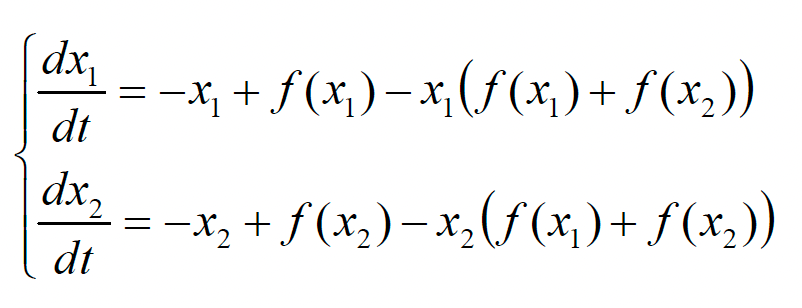
The expression
is the CHANGE IN THE ACTIVATION of NEURON 1 over time. Thus, these two equations express how the ACTIVITY of each neuron CHANGES over time, and that the changes in one neuron are based upon the current activity of both neurons.
The SELF-EXCITATION TERM is
This expression governs how a Neuron excites itself when active.
The CROSS-INHIBITION TERM is
This is the math that characterizes how the activity of each Neuron gets inhibited with an inhibitory strength proportional to the present activity of the Neuron (x1).
The initial term
is a DECAY TERM. This math expresses how a Neuron’s activation is constantly driven to zero in the absence of inputs. This term puts steady pressure on the Neuron to shut off over time.
To evaluate the mathematics of the system, we will examine our thinking system when it has reached equilibrium—when it has reached a stable steady state without further change. In other words, we will examine our two-neuron competitive net when
indicating that all inputs from the brain into our thinking network are unchanging and fixed at zero.
The term
is a mathematical FUNCTION. This function characterizes the mechanics of each individual Neuron’s ACTIVATION SIGNAL and is known as a piecewise linear function. It looks like this:
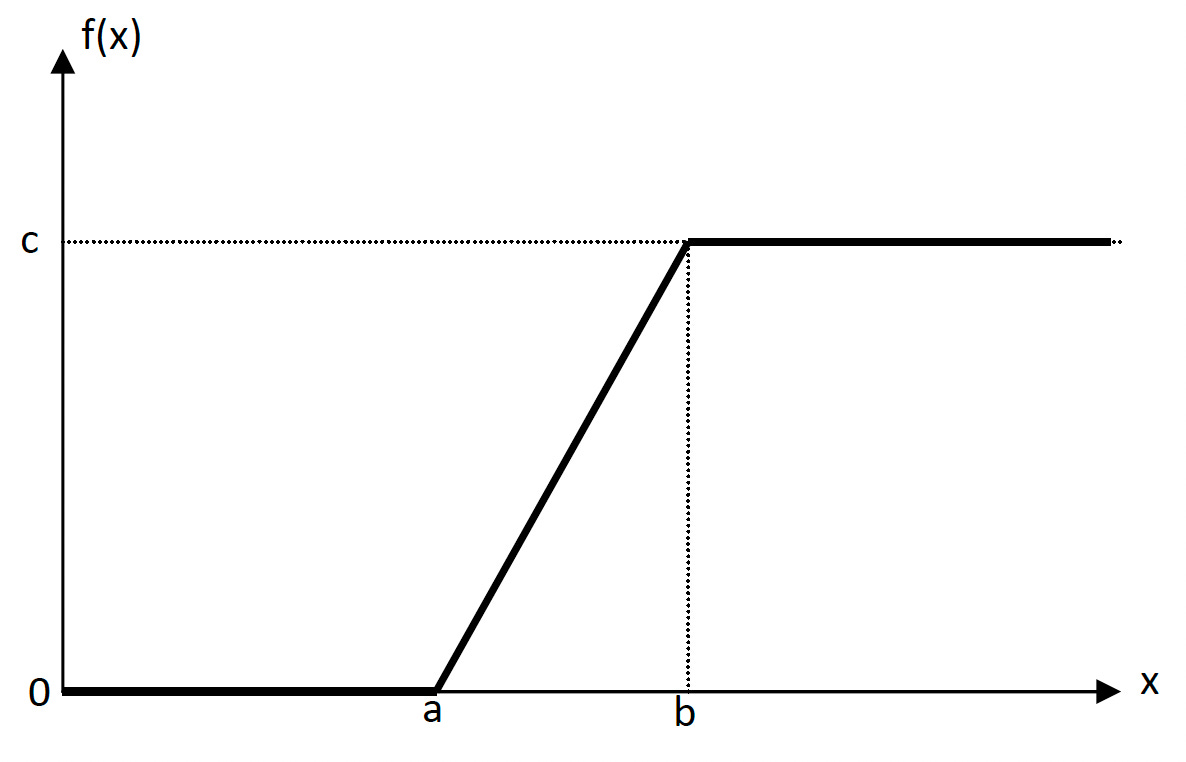
We’ll explain the significance of this function and its shape later. For now, think of this function as a streamlined mathematical model of an actual biological neuron’s “activation function”—the biomechanical signal transmitted down a Neuron’s axon when the Neuron is triggered to fire.
The function f(xn) converts the neuron’s activation intensity xn into an output signal of intensity f(xn).
.3 The Natural Fallacy of Sentience
We have mathematically characterized our mechanical system.
We have delineated precise quantitative descriptions of how the ACTIVITY of our Neurons changes over time.
It’s worth pointing out that the two equations, above, do not describe some perfect mystical Platonic object that exists in some alternate dimension. They describe two mechanically imperfect neurons in the real world.
What actually exists—the cosmic truth—is two neurons signaling to one another. That’s what’s really happening in reality. In contrast, what’s really happening inside your brain when you think about the two-neuron network is math. A happening which your brain uses to make sense of the cosmic truth of our two-neuron thinking network.
We—me and you, fellow human!—need a way to communicate about the mechanics of these neurons with one another. We need communication that enables us to understand the neurons, act upon the neurons, and/or build new thinking networks. We need a way to communicate that enables our brains to share consciousness of the structure and operation of the thinking network.
The way is mathematics.
Even if you’re alone—maybe you’re the last human left on Earth!—you can use math to talk to yourself about thinking networks and thereby understand them, act upon them, and build them.
But no matter how much you meditate upon the math, no matter how pure the equation, no matter how compelling the mathematical revelation, you are not accessing a higher preternatural realm. You are not experiencing a mystical connection to another dimension of purity and perfection. There is no such dimension. Not even Nirvana, not even Zero.1
Your brain is merely processing in real-time the mechanical truth of the two-neuron shunting competitive net and converting your hard-won conceptual and perceptual knowledge into the spoken, written, or imagined language of mathematics.
Incidentally, this is how superlearning would help someone like Max Tegmark, an avatar of overspecialization and tunnel vision and niche thinking and insularity and every other term that is the opposite of superlearning.
It’s good to have experience visiting many different worlds, including many higher and transcendent realms. It’s good to know poetry and ballet and sculpture and faith healing and sufism and other human mental activities designed to induce alternate states of consciousness which you can then compare with your personal experience of the mental activity you adore—math. It’s even better to have direct experience of god so you have something profoundly otherworldly to compare to your otherworldly experience of math.
Your natural-fallacy-of-sentience-induced experience of math.
That way you can see that you’re making a metaphysical argument about math—a faith-based argument, a feels-good argument rather than an experiential or empirical or mechanical argument about math.
Please consider:
It is humans choosing to assign the variable xn to represent the activation of a Neuron, it is biological brains choosing to define the activation function f(xn). Even though scientists will contend that these equations are the best possible mathematical characterization of the underlying dynamics of the system, such contentions are not provable, and perhaps a distraction. For math always involves human choice.
Math consists of choices of how to talk about mechanics with other minds.
We are choosing to characterize the mechanics through these two equations. We are guided by reason, intuition, evidence, theory, models, yes—but we still choose our math nonetheless. We do not mystically access interdimensional Platonic truths about neurons or thinking or purposeful activity and experience.2
That would be the same exact mistake as believing the word “neuron” possesses a higher reality that exists apart from palpable biological neurons in the real world. That there exists a “Shakespearean Realm” where every noun and verb floats in perfect purity. And further, that merely contemplating a mechanical neuron somehow triggers a mortal brain to experience unbidden cognizance of this secret invisible domain of words—that always and forever the sacred word “neuron” was awaiting a soul to come along and recognize its eternal presence in the Shakespearean Realm.
No. Again, the natural fallacy of sentience.
.4 Visualizing Math Through Phase Planes
Let’s explore our equations. What does the math reveal about the underlying mechanics of our thinking network?
One way we can visualize the operation of our thinking network is by creating something known as a PHASE PLANE DIAGRAM.
Here is a very simple phase plane diagram in two dimensions:
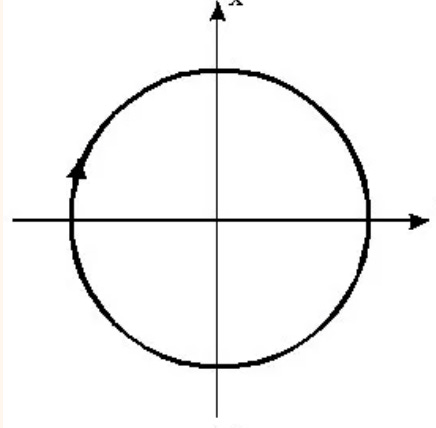
What this phase plane tells us is that there is a SINGLE TRAJECTORY of activity. A circle or loop of activity that goes round and round in a clockwise direction. Maybe this phase plane diagram characterizes the orbital activity of the moon, relative to the Earth.
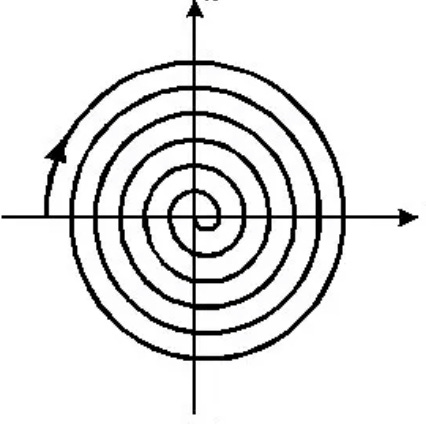
Here is another very simple phase plane diagram. This shows a spiraling trajectory. Any activity in this system will loop in a clockwise direction that steadily approaches the origin, where all activity ceases.
We say the origin (the point [0,0] in the coordinate plane) is an attractor. This is a term when discussing phase planes that refers to the behavior of the phase plane near a special kind of point known as a critical point.
A critical point is a condition of the system in equilibrium. A place where the system does not change. In the above phase plane of a spiraling trajectory, when the activity in the system reaches the origin—the center of the spiral—it will never leave. The system will remain in the attractor critical point forever, unless something external perturbs the system.
There are three common and crucial types of critical points to know when exploring minds and thinking networks:
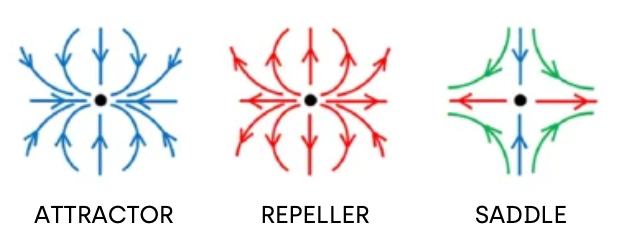
All the trajectories around an ATTRACTOR lead into the attractor.
All the trajectories around a REPELLER lead away from the repeller.
Around a SADDLE POINT, some trajectories lead into the saddle, while other trajectories lead away from the saddle.
We will create a phase plane diagram depicting the FLOW OF ACTIVITY in our two-neuron thinking system. We will render our math as a visualization. This is another form of communication for minds—a way for two brains to share the same awareness of the mechanics of our thinking system.
Our visualization—our phase plane—will make it easier to grasp the mechanics of our on-center off-surround shunting net.
How do we go about making a phase plane diagram for our system?
First, we must recognize that there will be many phase planes for our system, because there are three variables that influences the behavior of the system: a, b, and c. Recall the activation function f(xn):
a, b, and c are called parameters. They are parameters of the piecewise linear activation function. (They are called dimensionless parameters because they have no physical units; mass is not a dimensionless parameter because it involves units like kilograms or pounds, while the Richter Scale is dimensionless because a Richter magnitude is a ratio between two values, and therefore a non-physical abstraction.)
In an on-center off-surround shunting competitive network, these three dimensionless parameters influence the behavior of the network and even determine the MEANING of the network, as we’ll see.
So our initial aim while exploring the mathematics of our thinking net is to create phase plane diagrams using different values for parameters a, b, and c.
Let’s go!
Nirvana (Zero) exists, but it does not contain pure objects or Platonic exemplars. It contains no “things” nor any stable “knowableness.” It’s beyond activity and thing, beyond dualities.
Readers of the Dark Gift might wonder about my own “mathematical visions” that I received from Five in the Maze of Souls. Weren’t they “mystically accessing another dimension”? No. That was not how I experienced them.
I experienced these “visions” in conversation—in communion—with another mind, Five. Five shared these ideas with me, as I am now sharing equations and phase planes with you.
And just as you must invest the time to understand the equations and diagrams I am sharing with you—you certainly won’t instantly grok the dynamics of a two-neuron on-center off-surround shunting competitive network just by looking at its equations (unless you’re previously trained in neural dynamics)—I had to invest the time to understand the visions that Five shared with me.